
Is damaging hail getting worse? First comprehensive global study of very large hail in a changing climate reveals contrasting trends and different causes.
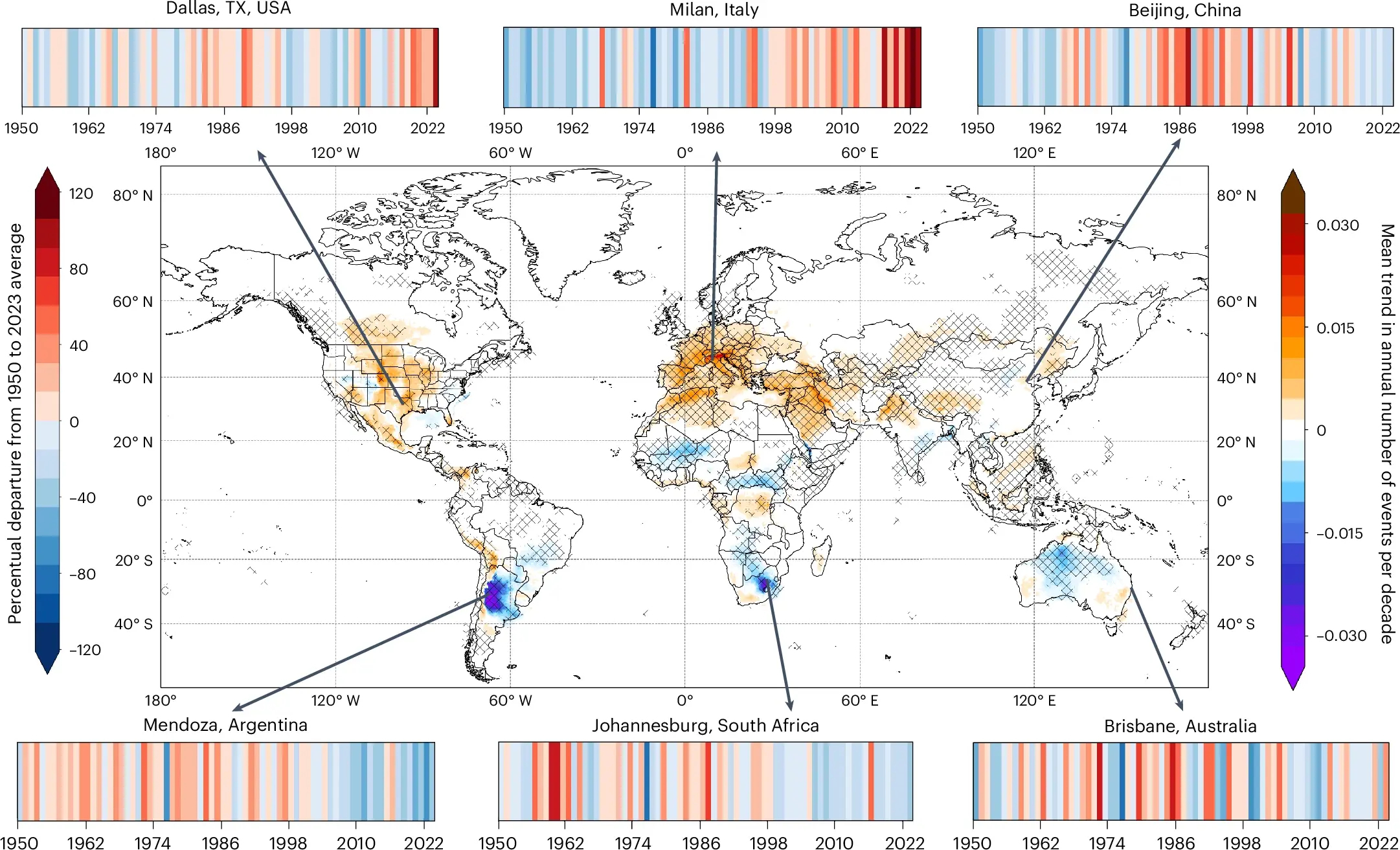
For the first time, scientists have modelled the occurrence of hail larger than 5 cm globally. European storm researchers, led by ESSL scientist Francesco Battaglioli, analysed long-term trends of hail frequency and associated economic losses over the past 30 years. While very large hail is most common in parts of South America, the United States and South Africa, the study reveals that the strongest increase in frequency has occurred in Europe. In contrast, some regions of the Southern Hemisphere have experienced a decline. Changes in atmospheric moisture near the surface are primarily responsible for these trends.
Although hail-related losses have increased across Europe, with several multi-billion-dollar losses over recent years, the meteorological changes are only partly responsible for this increase. Rising losses are also driven by greater exposure and vulnerability: as more homes and infrastructure are built in hazard-prone areas, the potential for damage increases. This effect is a key driver of rising losses in the United States and along Australia’s coastlines.
The study was published in Nature Geoscience and lead-authored by the European Severe Storms Laboratory (ESSL) in collaboration with experts from the Adam Mickiewicz University of Poznań (Poland) and German reinsurer Munich Re (Germany). In the first two weeks after publication, more than 4500 accesses of the online paper were counted, demonstrating high interest.
Reference: Battaglioli, F., Taszarek, M., Groenemeijer, P. et al. Contrasting trends in very large hail events and related economic losses across the globe. Nat. Geosci. 19, 52–58 (2026).
https://doi.org/10.1038/s41561-025-01868-0
You can find the PDF of the ESSL press release here.