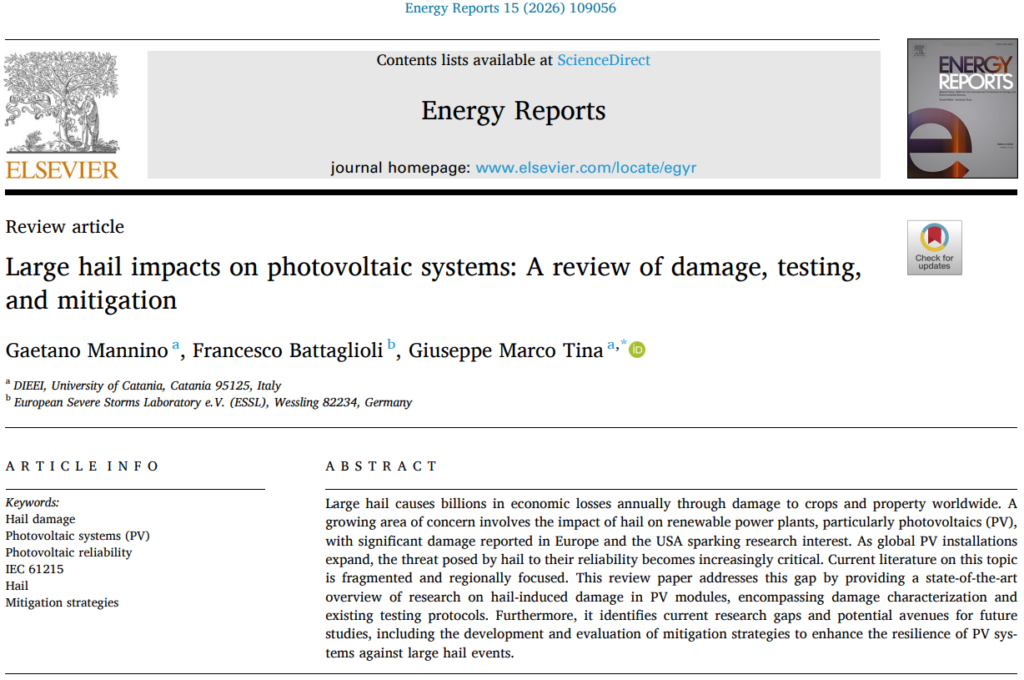
𝐄𝐒𝐒𝐋 𝐫𝐞𝐬𝐞𝐚𝐫𝐜𝐡𝐞𝐫𝐬 have partnered with the 𝐔𝐧𝐢𝐯𝐞𝐫𝐬𝐢𝐭𝐲 𝐨𝐟 𝐂𝐚𝐭𝐚𝐧𝐢𝐚 to explore an area of growing concern for the 𝐞𝐧𝐞𝐫𝐠𝐲 𝐚𝐧𝐝 𝐢𝐧𝐬𝐮𝐫𝐚𝐧𝐜𝐞 𝐬𝐞𝐜𝐭𝐨𝐫. The modelled increase in the frequency of 𝐥𝐚𝐫𝐠𝐞 𝐡𝐚𝐢𝐥 events, especially in Europe, and the expansion of 𝐩𝐡𝐨𝐭𝐨𝐯𝐨𝐥𝐭𝐚𝐢𝐜 (𝐏𝐕) installations, urge for a better understanding of the damage and vulnerability of PV modules to these events.
The paper introduces 𝐄𝐒𝐒𝐋 𝐡𝐚𝐢𝐥 𝐦𝐨𝐝𝐞𝐥𝐥𝐢𝐧𝐠 𝐭𝐞𝐜𝐡𝐧𝐢𝐪𝐮𝐞𝐬 and puts them in perspective with existing 𝐦𝐢𝐭𝐢𝐠𝐚𝐭𝐢𝐨𝐧 𝐬𝐭𝐫𝐚𝐭𝐞𝐠𝐢𝐞𝐬, 𝐭𝐞𝐬𝐭𝐢𝐧𝐠 𝐩𝐫𝐨𝐭𝐨𝐜𝐨𝐥𝐬, 𝐚𝐧𝐝 𝐏𝐕 𝐦𝐨𝐝𝐮𝐥𝐞 𝐞𝐧𝐠𝐢𝐧𝐞𝐞𝐫𝐢𝐧𝐠, through a comprehensive review.
The paper “𝘓𝘢𝘳𝘨𝘦 𝘩𝘢𝘪𝘭 𝘪𝘮𝘱𝘢𝘤𝘵𝘴 𝘰𝘯 𝘱𝘩𝘰𝘵𝘰𝘷𝘰𝘭𝘵𝘢𝘪𝘤 𝘴𝘺𝘴𝘵𝘦𝘮𝘴: 𝘈 𝘳𝘦𝘷𝘪𝘦𝘸 𝘰𝘧 𝘥𝘢𝘮𝘢𝘨𝘦, 𝘵𝘦𝘴𝘵𝘪𝘯𝘨 𝘢𝘯𝘥 𝘮𝘪𝘵𝘪𝘨𝘢𝘵𝘪𝘰𝘯.” was lead authored by Gaetano Mannino. ESSLs Francesco Battaglioli is second author of the new publication in the journal “Energy Reports”.
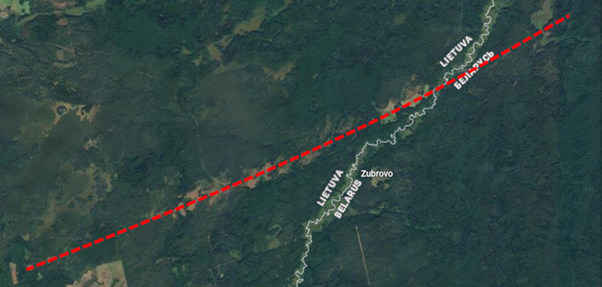
Thilo Kühne from the ESSL team, working on ESWD data and quality control, collected rare cases of tornadoes crossing national borders.
While the maintenance of a tornadic circulation is only a matter of physical variables and not influenced by political boundaries, there is still a statistical issue when it comes to the counting of tornado cases on a national level. This article discusses examples, the historical practice and current ESWD policy for such cases.
Tornado path of the IF1.5 tornado in the Lithuania-Belarus border area on 05 June 2025 based on satellite data showing forest damage and tree falls (mapping: ESSL, basemap: GoogleMaps)
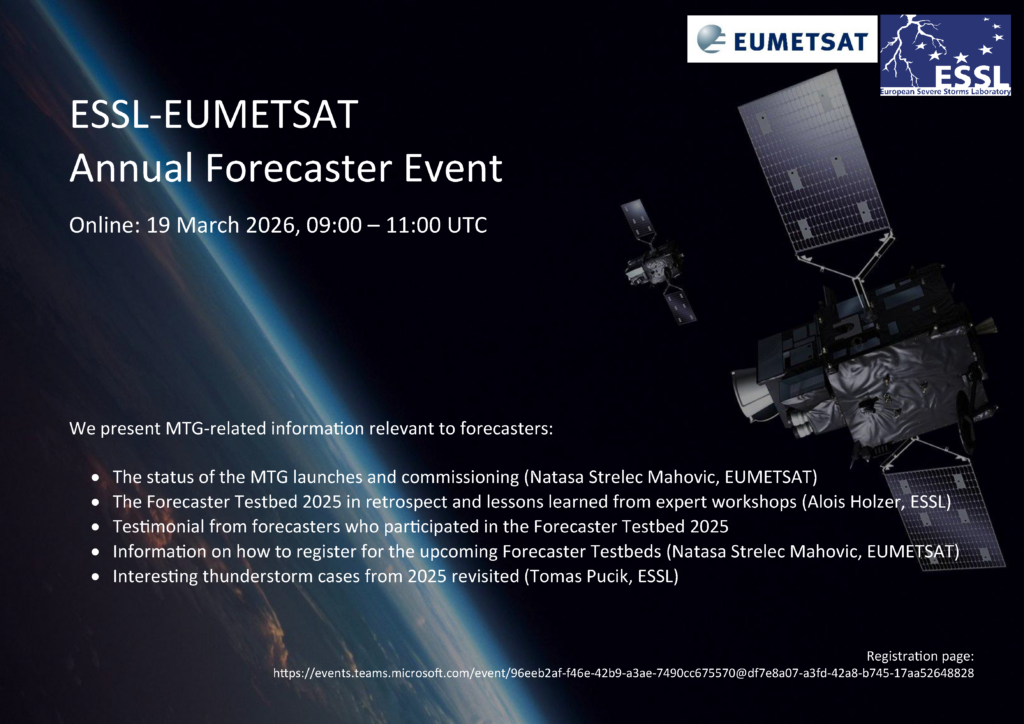
Online: 19 March 2026, 09:00 – 11:00 UTC Participation free of cost. Pre-registration required.
We present MTG-related information relevant to forecasters:
• The status of the MTG launches and commissioning (Natasa Strelec Mahovic, EUMETSAT) • The Forecaster Testbed 2025 in retrospect and lessons learned from expert workshops (Alois Holzer, ESSL) • Testimonial from forecasters who participated in the Forecaster Testbed 2025 • Information on how to register for the upcoming Forecaster Testbeds (Natasa Strelec Mahovic, EUMETSAT) • Interesting thunderstorm cases from 2025 revisited (Tomas Pucik, ESSL)
Is damaging hail getting worse? First comprehensive global study of very large hail in a changing climate reveals contrasting trends and different causes.
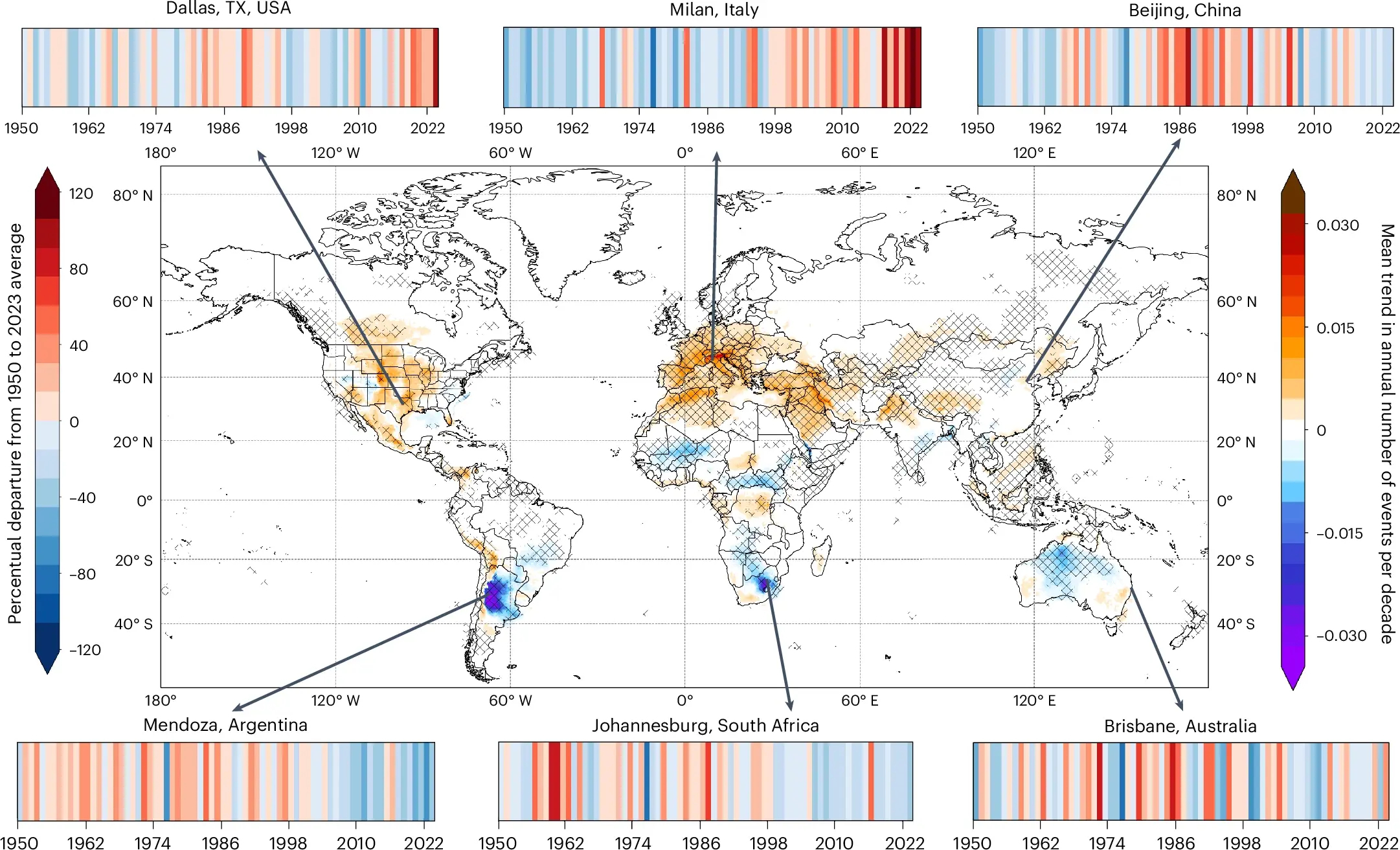
For the first time, scientists have modelled the occurrence of hail larger than 5 cm globally. European storm researchers, led by ESSL scientist Francesco Battaglioli, analysed long-term trends of hail frequency and associated economic losses over the past 30 years. While very large hail is most common in parts of South America, the United States and South Africa, the study reveals that the strongest increase in frequency has occurred in Europe. In contrast, some regions of the Southern Hemisphere have experienced a decline. Changes in atmospheric moisture near the surface are primarily responsible for these trends.
Although hail-related losses have increased across Europe, with several multi-billion-dollar losses over recent years, the meteorological changes are only partly responsible for this increase. Rising losses are also driven by greater exposure and vulnerability: as more homes and infrastructure are built in hazard-prone areas, the potential for damage increases. This effect is a key driver of rising losses in the United States and along Australia’s coastlines.
The study was published in Nature Geoscience and lead-authored by the European Severe Storms Laboratory (ESSL) in collaboration with experts from the Adam Mickiewicz University of Poznań (Poland) and German reinsurer Munich Re (Germany). In the first two weeks after publication, more than 4500 accesses of the online paper were counted, demonstrating high interest.
Reference: Battaglioli, F., Taszarek, M., Groenemeijer, P. et al. Contrasting trends in very large hail events and related economic losses across the globe. Nat. Geosci. 19, 52–58 (2026).
Mean trend in the annual number of very large hail events per decade between 1950 and 2023. Hail stripes showing the yearly occurrence of very large hail are provided for six metropolitan regions. From: Battaglioli, F., Taszarek, M., Groenemeijer, P. et al. Contrasting trends in very large hail events and related economic losses across the globe. Nat. Geosci. 19, 52–58 (2026). https://doi.org/10.1038/s41561-025-01868-0
You can find the PDF of the ESSL press release here.
In 2024, a record number of 9
institutional supporting members joined ESSL, probably as an indirect
consequence of the exceptional hailstorm damage that occurred in Europe in
2023. The Italian regional environmental protection agency ARPA-Emilia Romagna
joined ESSL as a full member. The new memberships provided ESSL with additional
financial means to help fulfil its goals of advancing scientific understanding,
building human capacity, and fostering cooperation within severe storm science
across Europe.
Indeed, several important efforts
were started or continued in 2024, most prominently the preparations for the
large field campaign Thunderstorm Intensification from Mountains to plains, or TIM, which involved a large amount of
coordination and exploratory work with potentially interested parties, and the
authoring of a whitepaper
to scientifically underpin the motivation for the campaign. In addition, we
started developing a new implementation of the European
Severe Weather Database, which would become operational in the third
quarter of 2025. A third major investment was in the development of a new
component of the ESSL Weather Data Displayer that would show Doppler radar data
from European radars. At a course in December 2024, it would be used for the
first time. Furthermore, a separate legal entity ESSL Services GmbH was founded
to carry out services for ESSL members and others, such as developing hazard
models or providing access to ESSL’s Weather Data Displayer.
Weatherwise, 2024’s most impactful events were related to heavy rainfall. The most prominent event by a large margin was the tragedy that unfolded near Valencia in eastern Spain on 29 October, where, sadly, a total number of 219 fatalities occurred as a result of a storm system that remained quasi-stationary over the region for many hours. In addition to this event, severe autumnal floods with more than a dozen fatalities also occurred in Morocco and in Bosnia-Hercegovina. The western Balkans also were the hot spot of large hail occurrence in 2024, although the total impact of hailstorms was considerably lower than in 2023, because hailstones of exceptional size were considerably rarer. The number of requests for ESWD data by non-members stayed at approximately the same, high, level as in 2023. An overview of severe weather is given in Chapter 1. This Annual Report also gives an update on the various research projects that ESSL scientists were working on, the largest of which were CHECC, PreCAST, and the collaborative projects with ECMWF. These projects resulted in significant advancements in forecasting severe weather in the medium range, where considerable predictability of hailstorms was noted to extend to 10 days in advance. Furthermore, projections of the future hailstorm climate based on the CMIP6-generation of climate models were obtained.
It is a collaborative project including Italy, Czechia, and the Netherlands.
The Tooming Award is the ESSL award with the longest tradition. It fosters the idea of pan-European collaboration in the severe storms research community.
The Heino Tooming award was instigated in 2007 in the memory of the outstanding Estonian scientist Prof. Dr. Heino Tooming (see photo to the right). Eligible is any excellent scientific presentation at the European Conference on Severe Storms (ECSS) by a group led by a European scientist and involving collaborators from at least one other European country, fostering in this way collaboration across this continent in the field of severe weather research.
We thank our local organizing partner, the KNMI – Royal Netherlands Meteorological Institute, EUMETSAT, and the European Meteorological Society for their support in making this conference possible.
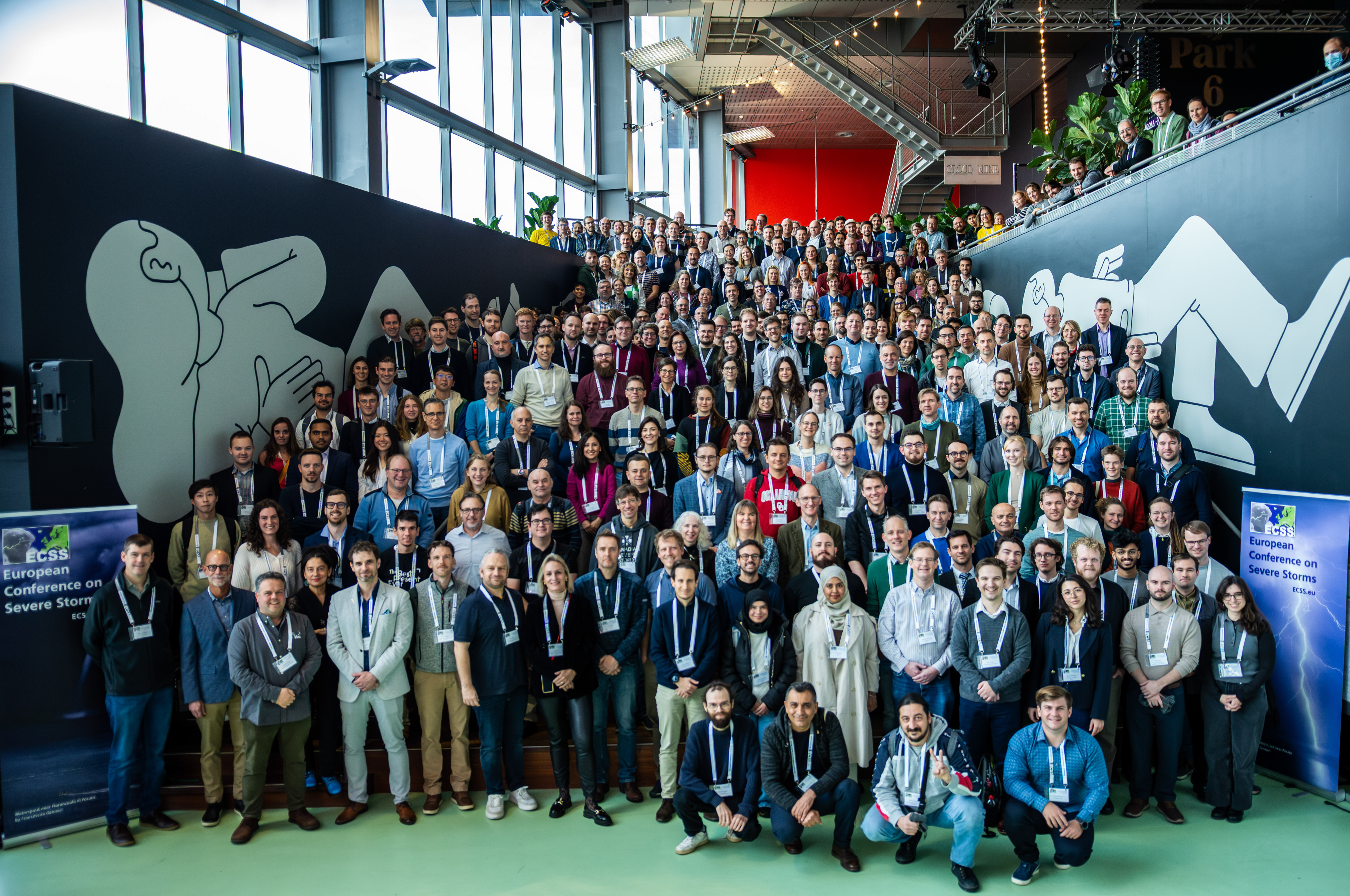
Official ECSS2025 Conference Photo (photo credit: ESSL, Igor Laskowski)
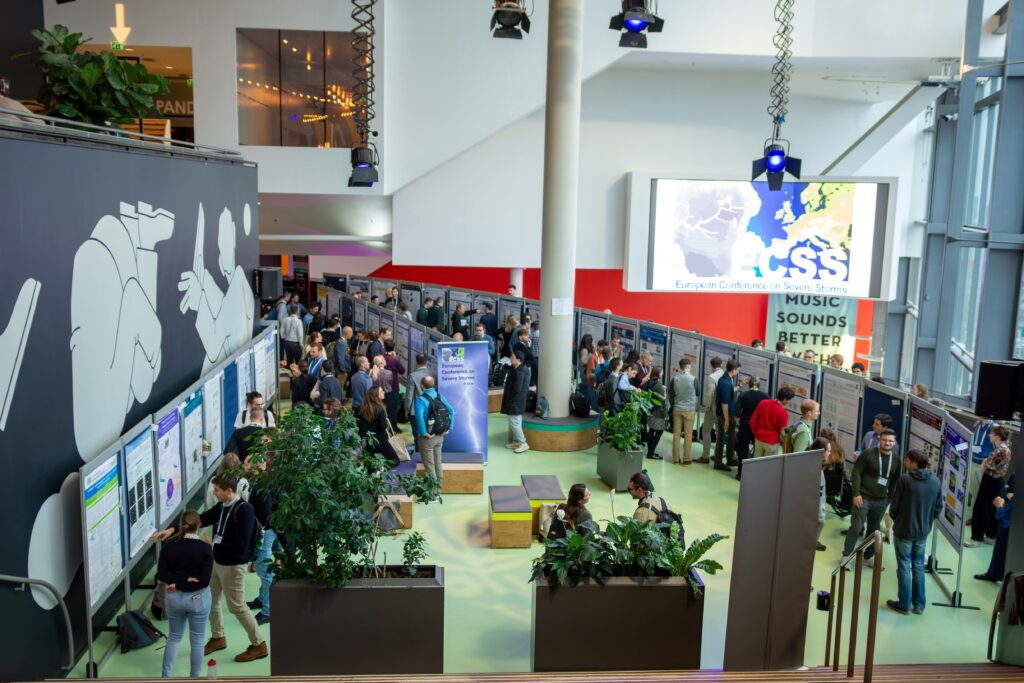
Next to the record numbers, many participants have been very pleased about the outstanding scientific excellence presented at the conference by a highly dynamic and competitive research community.
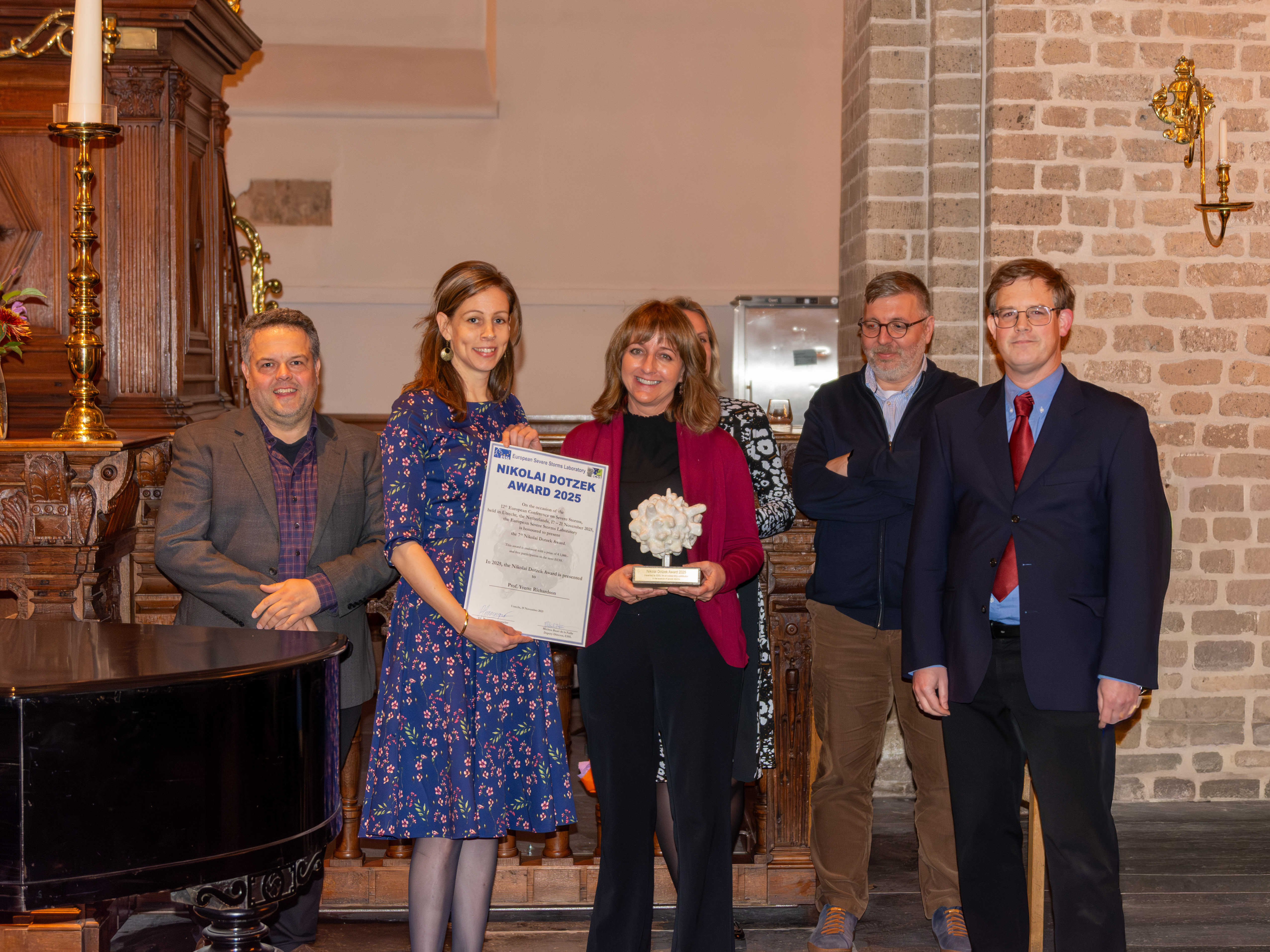
The 𝗡𝗶𝗸𝗼𝗹𝗮𝗶 𝗗𝗼𝘁𝘇𝗲𝗸 𝗔𝘄𝗮𝗿𝗱, the most prestigious prize in the severe weather research community, is presented every second year in memory of ESSL’s founding father, Dr. Nikolai Dotzek, for an outstanding contribution to the science of severe storms.
This year, the Nikolai Dotzek Award went to Professor Yvette Richardson (Penn State University, US) for her outstanding contributions to understanding tornadogenesis and supercell dynamics and for her immeasurable impact on science through supervising students who have gone on to develop impressive research careers of their own.
Nikolai Dotzek Award Ceremony at the ECSS2025 Conference Dinner on 19 November 2025 in Utrecht, the Netherlands. From left to right: Alois Holzer, ESSL; Michou Baart de la Faille, ESSL; Yvette Richardson, Penn State University – Nikolai Dotzek Awardee 2025; Bogdan Antonescu, ESSL; Pieter Groenemeijer, ESSL. Photo: ESSL, Igor Laskowski.
Professor Richardson’s research encompasses the complete spectrum of severe convective storms. Her research integrates state-of-the-art numerical modeling with cutting-edge observational approaches to understand storm formation and evolution. Her modeling studies have systematically investigated how temporal and spatial variations in environmental parameters influence supercell strength, rotation, and longevity.
On the observational side, she has used mobile radars to capture the fine-scale structure of supercells, and working with Prof. Paul Markowski, pioneered pseudo-Lagrangian balloon-borne sensors that provide three-dimensional in-situ thermodynamic observations within supercells.
Her leadership in major field campaigns (e.g., VORTEX2) has fundamentally advanced understanding of the discriminators between tornadic and non-tornadic supercells, addressing one of the field’s most challenging forecasting problems. Beyond research, she co-authored the definitive textbook “Mesoscale Meteorology in Midlatitudes” (2010), now the standard reference for graduate education in this field worldwide.
For this accumulation of important achievements, it is ESSL’s pleasure to award Professor Richardson the 2025 Nikolai Dotzek Award.
A full day of the European Conference on Severe Storms was dedicated to the new MTG satellites and related topics. EUMETSAT as a co-sponsor of the ECSS and the ESSL were happy to see the strong interest and ongoing user uptake of the novel data. A record number of ECSS participants is a clear sign of the importance of this topic.
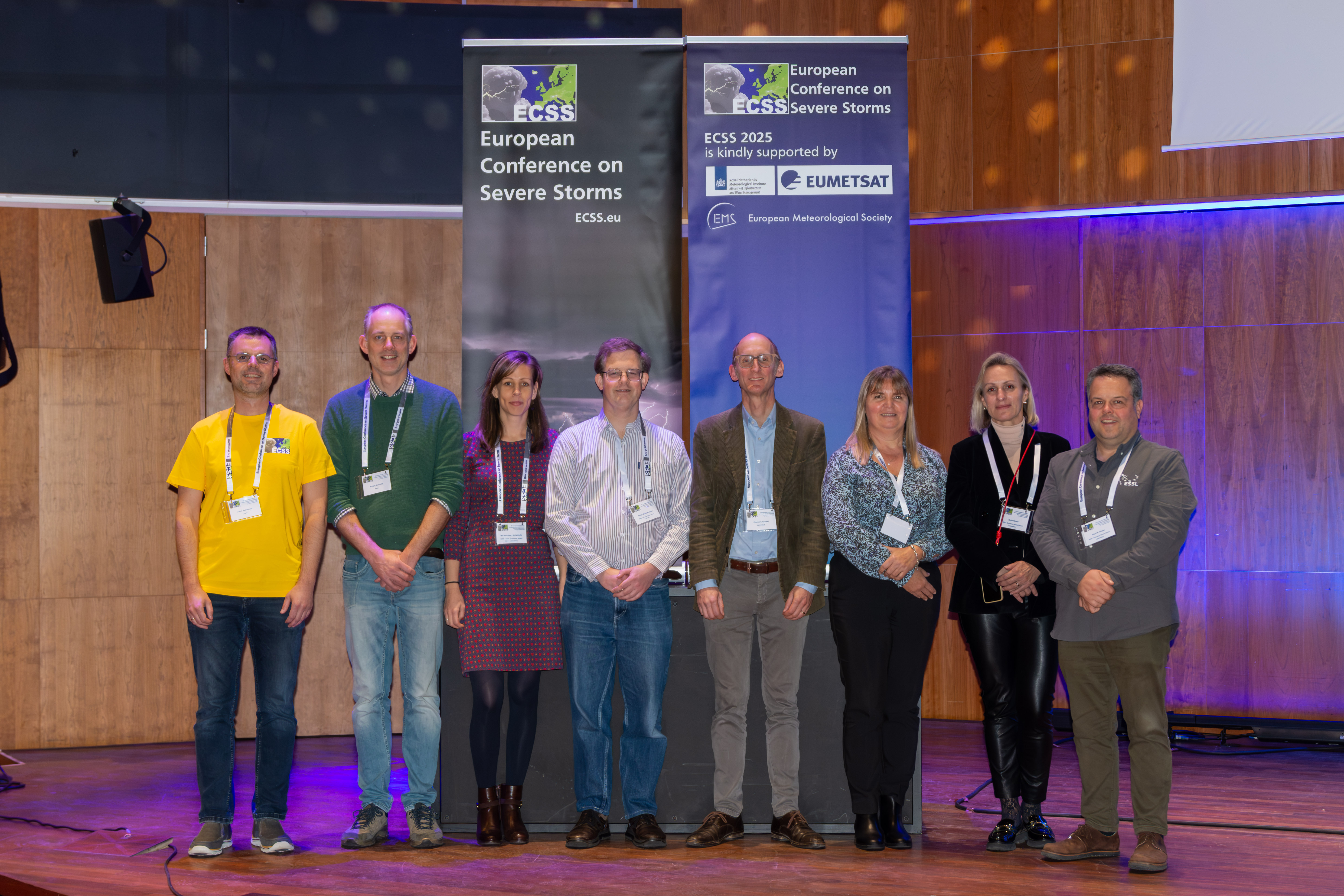
EUMETSAT representatives and conference organizers at the ECSS2025 stage (from left to right: Alwin Haklander, KNMI; Rutger Boonstra, KNMI; Michou Baart de la Faille, KNMI and ESSL; Pieter Groenemeijer, ESSL; Stephan Bojinski, EUMETSAT; Natasa Strelec Mahovic, EUMETSAT; Tanja Renko, ESSL; Alois Holzer, ESSL). Photo: ESSL, Igor Laskowski.
On 21 November, a forecaster workshop on MTG is offered. 70 forecasters from all over Europe are registered for that event.